



NETIS Energies Morocco Supports IBRAFROID in Its Transition to Solar Energy
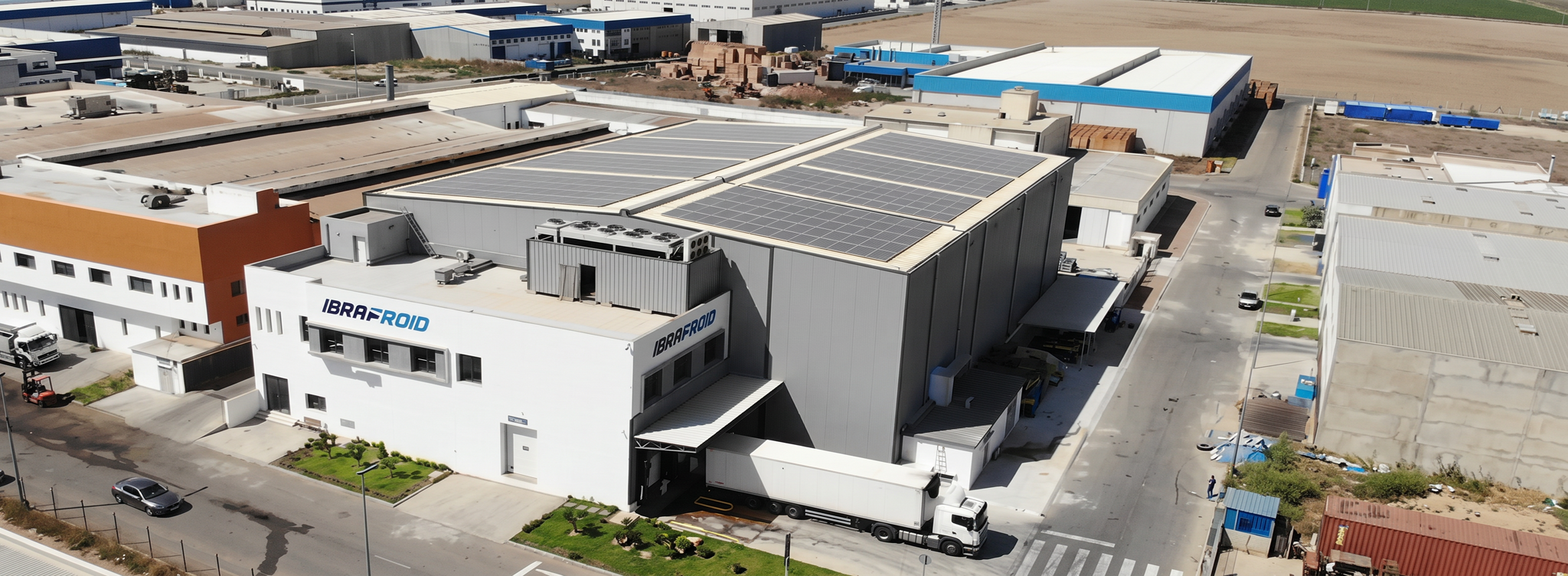
In Berrechid, NETIS Energies Morocco designed and delivered a 294 kWp rooftop photovoltaic system for IBRAFROID, a company specializing in food storage. The installation is designed to reduce energy costs while strengthening the site's environmental performance.
As energy cost management becomes an increasingly important challenge for industrial players, renewable energy is emerging as a key driver of competitiveness and sustainable performance.
Against this backdrop, IBRAFROID, a food storage specialist based in Berrechid, partnered with NETIS Energies Morocco to develop a photovoltaic solution tailored to its energy efficiency needs, particularly as part of its approach related to the SR500 subsidy scheme.
A Photovoltaic System Designed for Self-Consumption
To meet the site’s requirements, NETIS Energies Morocco delivered a 294 kWp rooftop photovoltaic system, enabling IBRAFROID to generate directly part of the electricity required for its operations.
The system comprises 450 Trina Solar photovoltaic panels rated at 655 Wp each, combined with two Huawei SUN2000-115KTL inverters and one Huawei SUN2000-50KTL inverter. The installation features a PRIMA mounting structure and is connected to the low-voltage (LV) grid.
Designed to maximize the on-site use of solar energy, the installation enables IBRAFROID to increase its reliance on self-consumption and reduce its dependence on grid electricity.
Delivering Tangible Energy Performance
The photovoltaic system is expected to generate approximately 470,509 kWh of solar electricity annually.
This production is estimated to cover 23% of the site’s annual electricity consumption. During peak and full-load hours (HPL), the coverage rate can reach 49% of electricity consumption during these periods.
Beyond renewable energy generation, the project also offers direct economic benefits for IBRAFROID, with an estimated return on investment of 4.4 years.
These results demonstrate the value of a self-consumption approach for industrial sites whose consumption profiles allow them to make direct use of the electricity generated during daylight hours.
Reducing Costs and Carbon Footprint
The installation also contributes to IBRAFROID’s environmental objectives.
Based on an emission factor of 700 g CO₂-equivalent per kWh, the estimated annual production of 470,509 kWh could help avoid approximately 329 tonnes of CO₂-equivalent emissions per year, subject to confirmation that the emission factor is appropriate for the electricity mix used as the reference baseline.
Beyond these figures, the photovoltaic system represents a tangible lever for supporting the site’s energy transition, combining economic performance, energy efficiency and the use of renewable energy.

NETIS Energies Expertise Serving Moroccan Industry
Through this project, NETIS Energies Morocco reaffirms its ability to support industrial companies in the design and implementation of energy solutions tailored to their operational needs.
From assessing energy requirements to delivering the photovoltaic installation, NETIS Energies takes a site-specific approach to developing solutions that generate measurable long-term value.
The project delivered for IBRAFROID reflects a broader ambition: leveraging NETIS Energies’ expertise to enhance the energy performance of Moroccan industrial companies and accelerate their transition towards more sustainable energy models.






Comments are closed